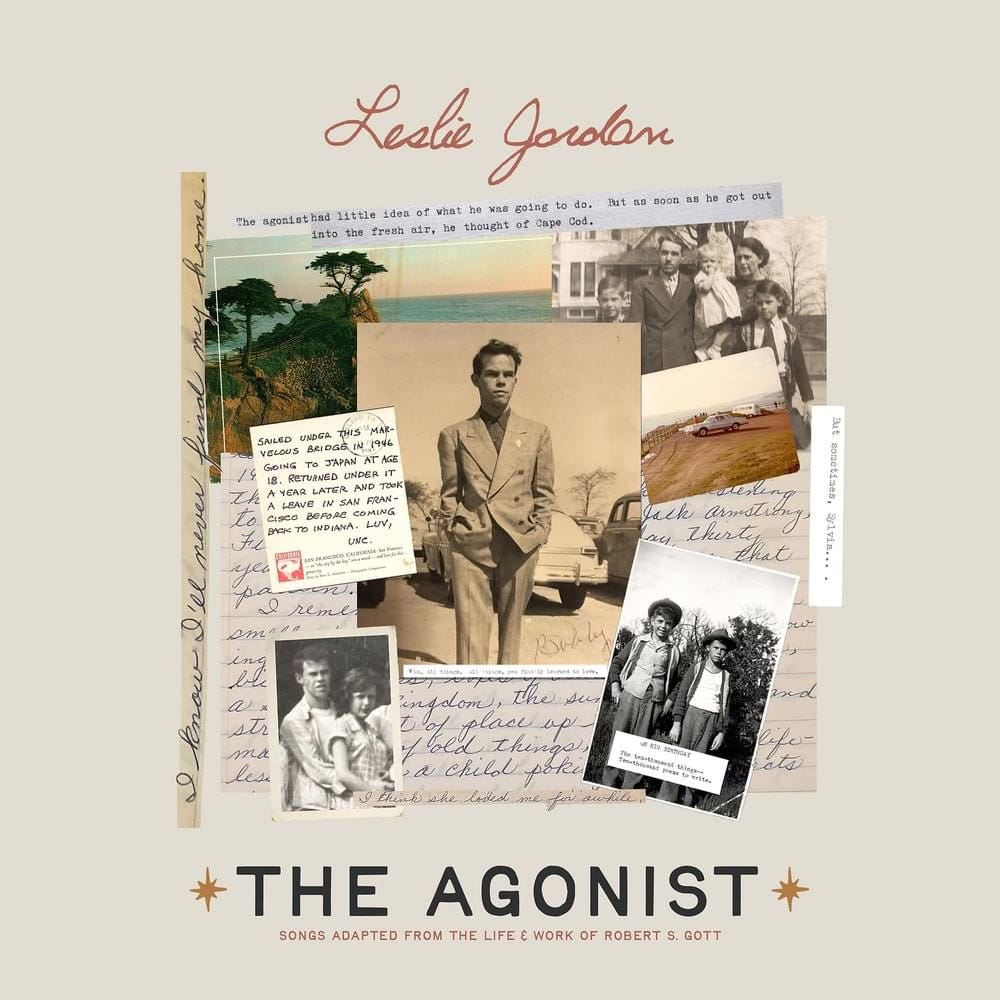
I have been aware of Leslie Jordan for a few years. When Anna and I belonged to a non-denominational church, I played guitar on the worship team and noticed Jordan’s name in the credits of some of the songs we sang in church. I quickly realized that she and I have a lot of mutual friends who are all adjacent to the Rabbit Room community and when her, Jess Ray, Sandra McCracken, and Taylor Leonhardt released their album, Paper Horses, I became a fan.
You can imagine my intrigue and excitement when an ad came across my screen for Jordan’s new album, The Agonist. First, I was struck by the title. I had a concept for an EP at one time that would attempt to tell one story from three perspectives: the protagonist, the antagonist, and the agonist. I never got around to writing those songs and I fully believe that ideas are not our own. If you do not do anything with the seeds gifted to you, they will be gifted to someone else.
Secondly, I was very intrigued by the personnel she had surrounded herself with in making The Agonist. Kenneth Pattengale (of The Milk Carton Kids) was producing with amazing support from musicians such as Gabe Witcher, Tyler Chester, Sara Watkins, Joey Ryan, and my own dear friend, Laura Epling. Some of Leslie’s songs were also cowritten by the aforementioned Sandra McCracken and Taylor Leonhardt. Those were just the names that popped out to me immediately.
Lastly, as I previously mentioned, I had known Jordan as a songwriter in the Christian music industry and from what I could tell, this was not going to be like anything like that. I was elated.
Released in the spring of 2025, The Agonist tells the incredible story of her estranged grandfather; a man she never met. Robert “Bobby” Gott was an alcoholic and had abandoned his wife and daughter to pursue life as a poet and a novelist in the 1950’s. The album title comes from a short story he wrote in which he refers to himself as “an agonist”.
“That word haunted me,” Jordan tells Relevant Magazine1. “It gave me a character, a framework. It opened up this whole world to explore who he was—not who we wanted him to be, but who he actually was.”
Learning that the album was inspired by the writings of her grandfather’s complicated past encouraged me to lean in. My own paternal grandfather, a man who died before I was born, also had a complicated life. A Southern Baptist preacher until he and my grandmother divorced in the early 1980’s, Paul Edwards was an alcoholic and a bit of a womanizer. The difference between Jordan’s story and my own is that I grew up around the folks who knew him and praised his life as a Christian, yet my own father and grandmother never beat around the proverbial bush when they discussed his darker side.
The album begins with the title track; deep, dark tones spill throughout the track like a sunset in a Cormac McCarthy novel with Jordan’s vocal and lyric acting as the last glimpse of light across the desert.
Enter our protagonist
He calls himself the agonist
Never had a good thing he didn’t squander
The introduction to Bobby Gott describes him as a “poet and a prodigal, manic and methodical” and was born with “something begging him to roam”. Pattengales’s production really shines throughout this whole album and captures the somber reality of what Jordan describes as a “man without a home”. It’s beautifully eerie and utilizes a simply plucked banjo, a lonesome pedal steel, and gently thumped acoustic guitars.
Jordan’s ability to hold tension in such an elegant performance is unique and difficult to do. Most artists would succumb to the temptation of performing a song entitled The Fight with rowdy drums, angry distortion, and forced dissonance but that is not how she delivers the second track. So much of the magic behind her lyrics is a finely tuned texture that almost resembles foley art; a pump organ’s drone, something that sounds like a piece of metal being bowed, and three different guitars with very specific roles settle behind her interesting melodic choice for the hook.
Do you know how fast these hours pass
The lift of the love the weight it has
To have and hold, you have to know
The limit
Jordan empathizes with her grandfather’s loneliness in the major lift, Athensville. While I have already praised the songwriting on this album, a lot of the beauty comes from Jordan’s voice. The way she sings the lyric, “Athensville” is mature and intentional.
There ain’t no use in trying
He made up his mind
He would rather wander
Than live someone else’s life
He’s seen the ones before him
Get swallowed by their fear
But he ain’t afraid of dying
Just dying here
Madonna of Sierra Madre introduces a southwestern flair with horns and a soulful guitar solo. Golden Gate toes the line between melancholy and hope. Sometimes, Sylvia contains one of my favorite lyrics on the album:
I’m selfish, can’t help it
In search of secrets never told
Untethered, this weather
Too damn hot to feel this cold
The Agonist ends with two tracks that are perfect endings to a story as complex as the life of Bobby Gott. Elegy starts as a tent revival altar call and blooms into a beautiful anthem of redemption complete with soaring strings and a tear-jerking organ. All Things, a song featuring The Milk Carton Kids, ties a bow on the record with an intimate performance and Jordan seemingly forgiving the fleeting behavior of a man she never knew yet grew up with the consequences of his choices:
You finally learned to love.
Leslie Jordan created one of my favorite albums from 2025 and a wonderful example of what folk music is; a sprawling story that does not ignore the flaws of its agonist turned protagonist. While Jordan claims that good art isn’t about being polished and more about being obedient to the truth2, I will argue that The Agonist is beautifully both while wholeheartedly agreeing with her sentiment. I resonated with how Emily Brown of Relevant Magazine summed up The Agonist:
“If The Agonist has a thesis, it’s this: Your story matters, even if it’s complicated. Especially if it’s complicated.”3
Bravo.